
I was reading some Facebook status updates — signifying that obviously, I’m not a total social media moron who hates all things social — when I came across an interesting little comment:
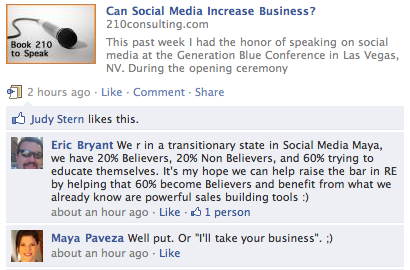
The post that Eric Bryant and Maya were talking about is this one by Jeremy Blanton. His conclusion:
I think in the case of these three the message is clear, social media can take your business and explode it to a whole other level. People realize the importance of social media in their business plan and it was evident by the packed classes that had anything to do with social media.
A lot of conversations — eternal ones, it appears — about social media as marketing is about whether it’s effective. Maya Paveza, a good friend of mine who was on that panel, threw down on Mike Ferry recently because Mike disparaged the efficacy of things like Twitter and Facebook (well, and she thought he was rude).
But let’s have a different conversation, because I’m sort of bored with the “social media works/social media is fool’s gold” stuff. Let us take as given for this discussion that social media is the single most effective marketing strategy ever invented for real estate. Let’s assume that it will take a real estate agent’s business and explode it to the next level. Okay? Okay.
My next question: should social media techniques be taught to everyone or kept secret for the chosen few?
Eric Bryant, Raising the Bar, and the Masonic Guilds
Freemasons trace their history back to medieval masonic guilds, which, like many other craft guilds of the time were strict societies of “master masons” who oversaw and trained groups of journeymen and apprentices. When you think about it, masonry is kind of amazing. Ancient Egyptians built the pyramids, and Greek temples that are thousands of years old still stand. These ancient masons using rudimentary tools, plagued with various superstitions, with none of the modern disciplines of architecture, engineering, and little understanding of physics nonetheless put structures together that fit perfectly and stood the test of time.

The whole craft of masonry, like many other crafts like metalworking, baking, and so on, was passed down from one generation to the next through the master-journeyman-apprentice system. If you wanted to become a mason, you found someone who already knew how to do it (often, your father), and learned it from him over years and years of apprenticeship and verbal instruction. Over centuries, certain architectural techniques (e.g., “ad quadratum“) of proven value came to be passed on, and became secrets zealously guarded by Medieval masonic guilds.
Given that knowing these skills — how to put up a cathedral, build castle, build a house — would generate enormous wealth (or at least a very comfortable living) for the mason, it was obvious that the guilds would only teach those skills to its members. And the guilds would take some pains to ensure that someone who is accepted into membership is a capable mason with professional ethics — since cutting corners could mean the cathedral collapses, thousands of people die, and the local baron rounds up a bunch of Masons for the gallows.
Eric Bryant, in his comment, suggests that 20% of real estate agents embrace social media, 20% despise it, and 60% are ignorant of it. And then he says that we can “raise the bar” in real estate by teaching social media to these 60% and making them “Believers”.
Thing is, I’ve heard numerous arguments that social media marketing can improve your business, make you a lot of money, and so on. I have never once heard that social media makes you more ethical, more competent or more knowledgeable about the practice of real estate. I’m a pretty advanced social media user; I think I understand it pretty darn well. I couldn’t tell you the first thing about doing an escrow in Texas. So even assuming arguendo that social media is truly effective, in the way that Medieval masonic secrets truly were effective, to make the leap that it will make someone a more virtuous, more professional REALTOR is unwarranted.
Indeed, many of the foremost experts advocating social media for real estate agree. Maya Paveza herself would gladly and easily agree that social media is but conversation, and that after you attract the attention/gain the trust/whatever, you still have to perform as a real estate agent, knowing how to price homes, stage houses, negotiate contracts, and so on. Jay Thompson has written eloquently about hiring only agents who have a passion for serving the customer… and he is a social media master, who can teach its mysteries and secrets to any apprentice. But he wouldn’t take an unethical, self-serving agent and turn her into a great realtor through the powers of social media. Because he can’t.
And spending just a few minutes on places crawling with social media experts and practitioners (I recommend the comments section of DailyKos), you quickly realize that social media in and of itself does not grant wisdom nor ethics nor kindness. It’s just a power, a tool, a technique like telephone, or knowledge of computer programming (assuming, again, that social media is indeed super-duper effective). You can use a telephone to build relationships, or you can use it to make death threats. The telephone itself is amoral.
If Social Media Is Power, Does Everyone Deserve It?
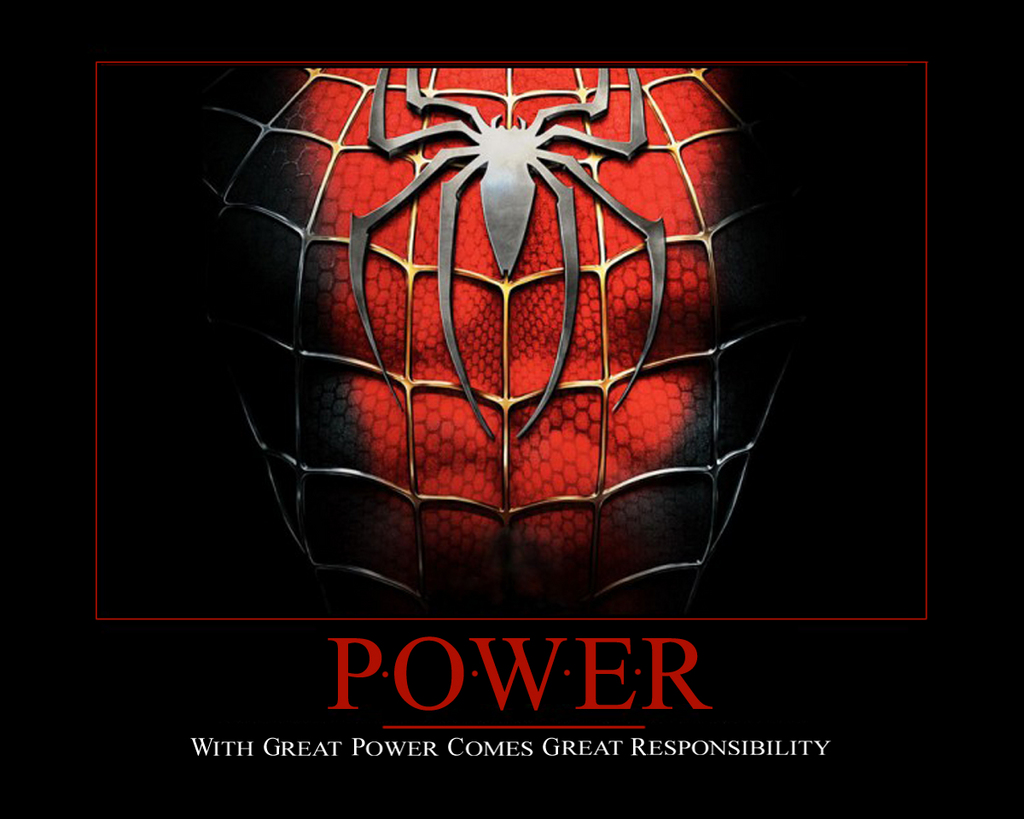
So let’s just agree that social media is a powerful tool, and understanding it grants the user real power. Let’s also agree that like all other tools, it is amoral.

We also know from the numerous Raise the Bar movements and conversations that the state of professionalism in the industry is pathetic approaching catatonic. The stories that real estate professionals tell each other when they’re out of earshot of any civilians are simply jaw-dropping. Unethical shit goes down every single day in this business, and some agents are dangerously incompetent. We know this. Many of those who advocate for social media know this, because they’re also the ones in the forefront of the Raise the Bar movement.
So why would you teach these valuable skills and grant this power to people who frankly do not deserve to advise a family on a real estate transaction? Isn’t the goal of “Raise the Bar” to drive the incompetent and the unethical out of business? If they’re floundering because their old-skool techniques are no longer working, why give them a way to “explode their business to a whole other level”?
I can see three answers here.
One, you might reply, “Well, the 60% who don’t know social media are all fantastic, ethical local experts who really know how to care for a client, but they just simply don’t have the power of social media’. That reply, of course, would get laughed out of the room.
Two, you might say, “I only teach social media to fantastic, ethical local experts who really know how to care for a client.” And I would want to hear about the interview process that an applicant to your Social Media for Real Estate seminars must go through. Don’t have one? Giving the seminar at an open RE BarCamp? That event could be attended by the biggest scumbag ever to carry a real estate license, since there’s no screening for ethics or professional skills. And he would use the knowledge he gained, leverage social media to its fullest extent, and become the biggest rape-and-pillage-the-client REALTOR the world has ever seen. What sort of processes and systems are in place to ensure that social media is being taught only to the “good” people?
Or third, you might say, “Well, when I’m teaching social media, I’m just doing my job to teach social media skills. It’s not my job to check to see if the student is a good ethical realtor or not. That’s why we have state licensing boards and local Associations that ensure professional standards.” Which is fine… if immoral. I offer strategy consulting services, skills and techniques that are in and of themselves amoral; I would not go work for the Ku Klux Klan to help them with strategy, even if the Department of Justice Civil Rights Division exists to ensure racial harmony. Nor would I offer business efficiency advice to a pimp abusing underage prostitutes, since I don’t work for Planned Parenthood, even if the police exist to arrest criminals like him.
If you are in the 20% who Believe in social media, and you Believe that it is an incredibly effective, powerful tool that can improve the business of any real estate agent who uses it… don’t you owe it to yourself and to the rest of the industry — and to consumers who have to trust these agents — to teach it only to those who deserve to stay in business?
How Do You Square This Circle?
So if you’re a True Believer in the Power of Social Media — in other words, you don’t think it’s just a part of an overall communication/marketing mix, but really believe that social media marketing is the most important factor for success in real estate going forward, able to breathe new life into moribund business — how do you square the circle?
Either (a) social media is incredibly effective and incredibly powerful, and therefore needs to be kept out of the hands of those who don’t have the requisite professionalism, knowledge, and ethics to be a great realtor; or (b) social media is not all that effective, could be taught to everybody, because only the really professional would devote the time and energy to pursue it… in which case, all this triumphalism talk has to stop. And bring the rhetoric down a notch or two about the power of social media, no?
Your thoughts and comments, as always, are welcome.
-rsh


12 thoughts on “Should Social Media Be Taught to Everyone?”
Rob why r u always making me think at 3am?
Maybe there are more options beyond a and b.
E.g.; maybe SM in all its power could be used for the good, to prove/ display competency/incompetency like heidegger would have us consider.
Heidegger? As in Martin? Now I’m curious. 😀
Whether I believe it is a tool or just another way to communicate, I do note as Jillayne above eludes to that if one is a “tool” off-line there is a fairly significant chance that trait will come through on-line as well 🙂
Ok, you made me think too early this morning. I know from now on that when I get a pingback to Notorious to not come read before 1PM 🙂
Rob –
Most of the “strategies for success” in social media require the active participation and transparent endorsement of others. SEO is a team sport.
So, even if the scumbags are given a proven social media blueprint, they’ll still have to trick a bunch of people into helping them. It’s possible, but unlikely due to the amount of time and blood, sweat and tears it takes to find a significant ROI worthy of justifying the effort.
Either way, I believe anyone can make it online if they work hard and smart enough.
Also –
You said:
” I have never once heard that social media makes you more ethical, more competent or more knowledgeable about the practice of real estate.”
Does this count?
http://www.wannanetwork.com/2011/02/05/whats-the-true-motivation-behind-your-real-estate-blog/
#3 – Online Resume – Substance Behind Your Brand
and
#4 – Community Advocacy – Rebuilding Through Education
Maybe I read too much into your writings, but I think we’re starting to go in circles? That’s OK because I am following the story line and it’s a good one. IMO, people do business with Goldman because (in theory) they have the best people, tools, research and results. Those that do business with the guys from “Boiler Room” or “Glengarry Glen Ross”, have lower expectations or are more apt to be sold by a glossy brochure and fast talk. As you know, there are a lot of brokerages that fall somewhere in-between.
Having access to social media doesn’t mean it will be useful. We are what we write, and then if the customer gets close enough, we are whom we are (for real). Real estate is local and until the transaction moves online; the phone, face-to-face meetings, direct mail, and all the Internet offerings will be the tools we, as brokers and agents, use to capture the buyers and sellers of residential real estate.
The use of technology, for the good is the goal. The challenge is that each person’s definition of the word “good” might be different.
Using any kind of technology just to treat people like objects so we can turn them into leads and convert them into clients as a mean$ to an end with no regard for our clients into and of themselves is what corporations do best. The people in those corporations have to be the ones, even if it’s just one voice, to stop and ask questions about what it is we value, such as respect, honesty, responsibility, justice/fairness, and so forth.
Real estate is a unique business because agents/brokers are competitors yet they are duty bound by their MLS rules (and/or their Realtor Code of Ethics) to cooperate with each other….for the greater good.
There will always be people ready and willing to exploit customers and also real estate agents (e.g., “come to this bar camp on social media; buy this tech tool; sign up for this zip code)
Mentoring is, at best, structured at some real estate firms (Keller Williams comes to mind) and informal at other places and non-existent in market areas that are hyper competitive.
For the masses of r.e.agents, social media is no different than tech tools that came before: websites, email, cell phones, fax machines, photocopiers. There’s nothing magical about it. It’s just what’s happening today. A few years from now we’ll all be focused on another technology tool.
For the very few who choose to learn how to use it for the greater good and not as a means to an end, those are the people who are already teaching others how to use it, by virtue of being an example for others to follow.
This is a beautiful example of using new technology to manipulate the viewer using fear.
This organization is trying to extort lobbying dollars from Realtors.
NAMB is such a poster child for how to be unethical, it’s sad.
I think any good agent, or business person for that matter, understands that social media can be a powerful tool if utilized properly. Unfortunately, there will always be business people that misuse it. I don’t believe it’s something that can be kept a secret. It’s out there for everyone to use. I think it is the responsibility of anyone who is using social media as a business marketing tool to educate themselves. Learn what is ethical to post and what is not. Agents also need to keep in mind privacy issues of clients. Don’t post anything that can be a breech of confidentiality. Like I said, unfortunately, there will always be irresponsible idiots that use this tool. So I think if you feel a responsibility to educate others so they ARE NOT the idiots, then by all means, do so. SM is only as powerful as we individually choose to make it.
So you want to hear what I have to say on this topic…I don’t see the harm in teaching social media to everyone. Of course, there will be a bunch of people teaching social media to agents who have no idea how it can/should be used effectively — but that’s another conversation in itself.
I think it’s safe to say bad agents will fail quicker now than they would have 20 years ago. Sure, they may dupe one or two clients into hiring them and make a bit of money in the process. But if those clients are unhappy with the service they received, then they are extremely likely to tell others in a very public fashion — therefore, lessening the chance that the bad agent will get more business in the future (even if it’s only ever so slightly). And if a client has a great experience, they are likely to share that experience as well. If you suck offline you’ll suck online.
I think the end result of social media will mean good agents get more business and the bad agents get less.
Rob:
You totally missed the fourth option, the one I chose when we created the CSM certification and then when SMMI partnered to rewrite the e-PRO – We teach people to use technology and social media in an ethical and effective manner. Of course you can’t really be blamed for missing that because we’re the only course for the real estate industry that does that – We cover basic legalities of intellectual property, copyright and fair use, the moral implications of plagiarism, and the REALTOR Code of Ethics in detail as it refers to electronic communication. Oh, and by the way, we also teach them how to create a business plan to use social media to increase their business.
Yes, I think you can teach social media to everyone, you just need to teach them the ethical and effective way to use it.
Too late there are no secrets in online social media
Comments are closed.