

Thanks to travel, blogging is a bit light, but I did want to get this post out because more and more, I feel it’s a painful message that must be heard.
There are quite a few things that a real estate company can do to improve operations, but many of them will take immense amount of work, cultural changes, and rethinking the practice of real estate brokerage itself. There is, however, one thing that any company can do that will immediately pay dividends: design. All it takes is spending some money.
Start by reading this post by @Issue web magazine. It is an excerpt of a book “Rules of Thumb” by Alan Webber, the cofounder of Fast Company magazine. The excerpt speaks to Rule 28: Good design is table stakes. Great design wins:
Not long after that trip I went to Denmark for a conference that brought together architects, industrial designers, and graphic artists. I walked around Copenhagen, admiring the shops and stores, the comfortable restaurants, the overall ambiance of the place. Then I had a cup of coffee with a friend who had organized the gathering.
“Denmark has high wages, high taxes, and an expensive social safety net,” I said. “But your manufacturing is moving to cheaper countries. What’s the strategy for the future?”
“We’re not worried,” she said. “We intend to compete on the quality of our design. Denmark is famous for our design.”
Read the whole thing; it’ll be worth your time. Then think through the implications for real estate with me.
Design is Differentiation
Alan Webber writes:
Today design is differentiation. Companies use design to create distinctive products and services that capture their customers’ imaginations; to restructure their corporate operations; to unveil new logos and uniforms that express a fresh corporate identity; to develop new communications tools that connect with customers and shareholders; to build corporate offices that encourage and enable collaboration; to collect and share information across a global platform. Design is a way to solve deep-seated social problems. And design is a money saver, a way to simplify products and make them easier and less expensive to manufacture.
He goes on to speak about the work of people like J Mays at Ford and Jonathan Ive at Apple. He goes on to talk about companies like OXO and Bang & Olufsen.
In a previous post, I tackled the topic of Design vs. Technology — which was more important to a company’s longterm success. While I concluded there, and still believe, that technology was the more important, that does not denigrate the importance of design. And good design is a heckuva lot cheaper to get than novel technology.
So if design is differentiation, let’s take a look at how that might be expressed in real estate.
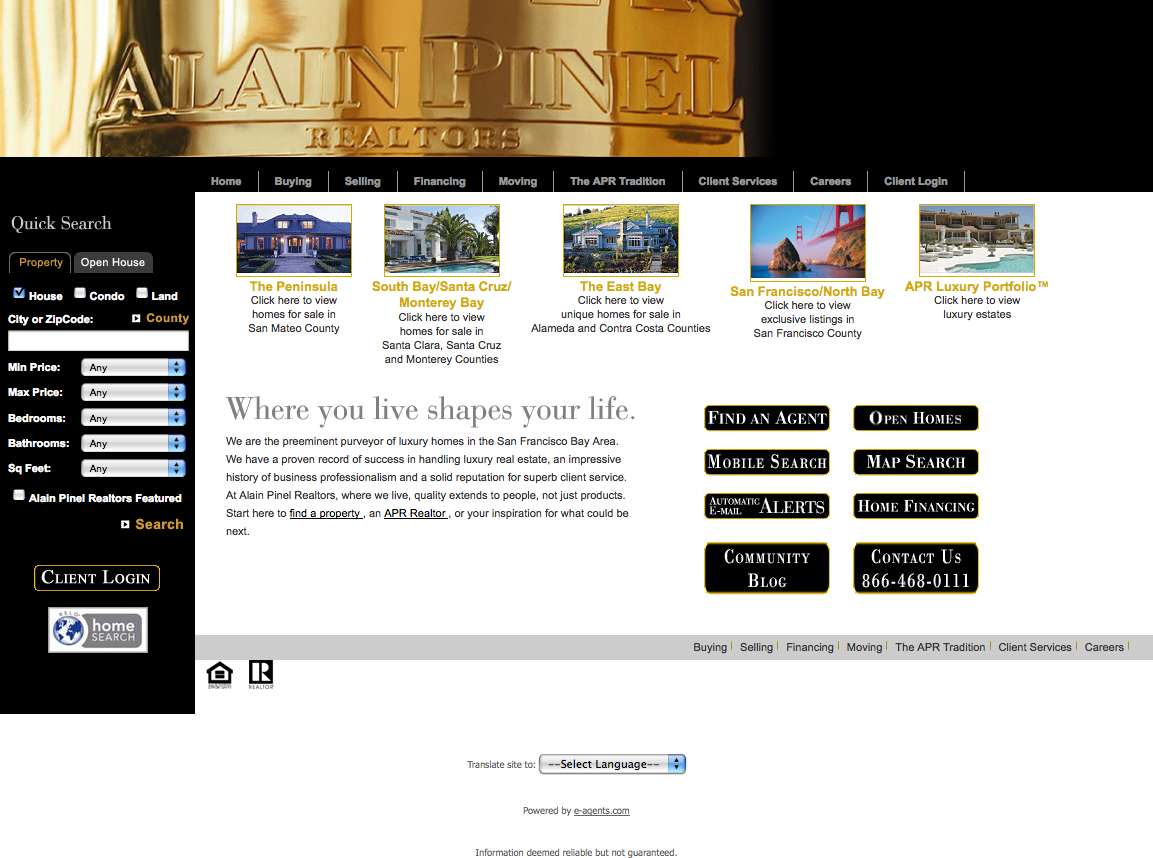

One of these website belongs to the 7th largest brokerage in the country with $7.2b in Sales in 2006, and over 1,200 agents working out of 24 offices. The other one belongs to the brokerage ranked 655th with $119m in Sales, with 37 agents working out of a single office. If you didn’t know the names of the companies, didn’t know their sales rankings, could you differentiate between the two based on design?
How can an industry giant like Alain Pinel, working in a luxury market where their average transaction size is $1.2m, have a website that cannot be distinguished from that of a single office brokerage working in an area with a $200K average transaction size? If you zoom into the bottom of the website, the answer appears:
“Powered by e-agents.com“
Really guys? With $7.2b in sales, which translates to roughly $180m in GCI and probably around $48m in company dollar… you went with a templated website maker for your corporate website? Oh, maybe you sprung for the “customized brokerage homepage” option. Saved some money, I guess?
Penny-wise, Pound-foolish
Alan Webber, again:
My guess is that most of you already get it. You already know that the design of your Web site says more about your brand than any thirty-second TV spot. You know that little—and not so little—things such as the design of your logo and letterhead, the design of your business card, and your office space all communicate instantly what your operation is all about, whether you’re a company of one or one hundred thousand.
Well, my guess is that most of you in the real estate brokerage business don’t already get it. You don’t realize that the design of your website says more about your brand than all of the glossy brochures produced at great cost to sit on the coffee table in your reception area. You don’t know that the design of your logo and letterhead, your business card, and your office space instantly communicate what your operation is all about.
Far too many of you decide to skimp on design across the board, save money (which is always a good idea) but at the expense of brand, of differentiation, of competition (which is almost always a bad idea).
I don’t mean to pick on Alain Pinel, but it is such a clear example of not investing in things that make a difference. It isn’t as if the websites of the top 50 largest brokerage companies in the country are filled with great designs that will be winning AIGA awards anytime soon. Even the companies that have spent the money with a web design firm haven’t necessarily produced great design. They have merely produced good design, which is table stakes.
I can’t help but be struck by just how badly designed so many real estate websites are. So many of them are cluttered, far too busy, filled with useless tripe, or merely indistinguishable from a thousand other websites. Print materials don’t fare any better. I’ve seen listing presentations which look like they were designed by a dyslexic color-blind baboon, and clients are supposed to assign million dollar properties to the care of an agent based on these documents?
Spend Some Money on Design, Yo
I feel I can say this with confidence, because I’m not a designer. My little company, 7DS Associates, is not a web design firm or an interactive agency. (Though we can do a lot of that for you <– see how I worked in a nice pitch there?) [ED: Yeah, real slick, Rob. /rolleyes.]
Spend some money on design.
Design means more than simply a pretty look and feel. And it doesn’t only mean website. Take a look at your logo. Your business cards. Your stationery. Your signage. Your yard signs. Hire a professional designer to come in and conduct a design/brand review for you and all of your brand materials.
I realize that budgets are tight, but you don’t necessarily have to spend a million bucks to get a clean, user-friendly, and unique design for all of your materials. Websites don’t have to have cool Flash movies and doodads and fun tools to be great design. (In fact, removing a lot of the clutter may be the hallmark of great design.)
Find a designer whose work really moves you and connects with you. Design is personal in many ways; what you find incredibly compelling might make me yawn, and vice versa. So find something that makes you go “Wow!” For me, there are a few websites that I find incredible that others don’t. I love the cleanliness and simplicity of Pentagram, of Subtraction, and of Cravath. But I also dig the razzle-dazzle of Pelli Clarke Pelli, of Goldman Sachs, and of Incase. (These are just websites, since I can link to those easier.)
Once you’ve found the right designer, be a great client. You’ve hired the right people, no? You believe in their skill; you have faith in their aesthetic sense. Let them be creative for you. Give them business goals you need to achieve, but then let them flex their creative muscles and come up with solutions you could not have imagined. And give them enough of a budget to make things possible — as much as you can possibly afford.
Implementing a great design doesn’t require a total overhaul of your internal processes. It doesn’t require that you reinvent your business model. It doesn’t force you into rethinking your structure. It doesn’t require coming up with a brand new disruptive technology. In that sense, creating and implementing great designs is the least expensive thing you can do to improve your business.
Think about it. Spend some money on design.
-rsh


31 thoughts on “Dear Brokers: Please Spend Money on Design”
Hallelujah. Totally agree.
Hallelujah. Totally agree.
What can I say… When you’re right, you’re right! I think the problem most big brokerages face right now is that they don’t know great design (at least the people making the decisions don’t) so they get quotes from a bunch of sub-par template vendors and choose someone in the middle. Then you’ve got companies like Redfin and ZipRealty that get design. Why is it that the rebate companies understand design and how to convey professionalism to consumers but the biggest brokerages don’t?
Simply because the rebate companies understand design. And they -have- to differentiate themselves from the rest. The giants are too big to make a decision in time to stay relevant. The tide sure is changing in this industry…
What can I say… When you’re right, you’re right! I think the problem most big brokerages face right now is that they don’t know great design (at least the people making the decisions don’t) so they get quotes from a bunch of sub-par template vendors and choose someone in the middle. Then you’ve got companies like Redfin and ZipRealty that get design. Why is it that the rebate companies understand design and how to convey professionalism to consumers but the biggest brokerages don’t?
Simply because the rebate companies understand design. And they -have- to differentiate themselves from the rest. The giants are too big to make a decision in time to stay relevant. The tide sure is changing in this industry…
Rob,
The problem is that corporate America (Real Estate or Not) does not put money into what they don’t understand, and they don’t understand Internet Marketing.
The reason they don’t understand it? Snake oil salesmen. There are just too many designers out there pitching web design with NO analytics, or historical performance to back up why they do what they do.
If Brokerage simply took the time to interview their Internet Marketing companies and ask one question… WHY. They would solve this simple problem. For every design element, there is a WHY. For every page, a WHY. For every Call to Action, a WHY. And for every why, there is a logical, dollars and sense answer.
Ask the question, understand the answer… and prosper.
Hey Jim – I totally agree that more brokers need to be asking better questions of their vendors. I’ve been thinking about trying to do more with the managers and support team of brokerages because while agents are being inundated with advice and knowledge, so few of the marketing/support professionals are being involved with what’s what.
But in any event, what I don’t quite get is why even designers who are pitching web designs with no analytics or historical performance produce such utterly crappy designs. I mean, let’s leave the whole “is it SEO compliant” thing to the side for a moment. Suppose the designer knows jackshit about SEO, about javascripting, about lead gen, etc. etc. Shouldn’t they know about DESIGN??? Shouldn’t the site at least be exquisitely beautiful?
Some of these templated designs are so bad that the clients should be suing the vendors for damaging their brand image in the marketplace. How is it that “professional” designers produce such craptacular stuff in our industry? That’s the mystery to me.
-rsh
Rob,
The problem is that corporate America (Real Estate or Not) does not put money into what they don’t understand, and they don’t understand Internet Marketing.
The reason they don’t understand it? Snake oil salesmen. There are just too many designers out there pitching web design with NO analytics, or historical performance to back up why they do what they do.
If Brokerage simply took the time to interview their Internet Marketing companies and ask one question… WHY. They would solve this simple problem. For every design element, there is a WHY. For every page, a WHY. For every Call to Action, a WHY. And for every why, there is a logical, dollars and sense answer.
Ask the question, understand the answer… and prosper.
Hey Jim – I totally agree that more brokers need to be asking better questions of their vendors. I’ve been thinking about trying to do more with the managers and support team of brokerages because while agents are being inundated with advice and knowledge, so few of the marketing/support professionals are being involved with what’s what.
But in any event, what I don’t quite get is why even designers who are pitching web designs with no analytics or historical performance produce such utterly crappy designs. I mean, let’s leave the whole “is it SEO compliant” thing to the side for a moment. Suppose the designer knows jackshit about SEO, about javascripting, about lead gen, etc. etc. Shouldn’t they know about DESIGN??? Shouldn’t the site at least be exquisitely beautiful?
Some of these templated designs are so bad that the clients should be suing the vendors for damaging their brand image in the marketplace. How is it that “professional” designers produce such craptacular stuff in our industry? That’s the mystery to me.
-rsh
Does what a site looks like REALLY matter?
Look at CraigsList. It’s a design nightmare.
I’m sure a designer would puke if they saw my blog. But it gets a pretty decent amount of traffic and despite it being a blog, 72% of the visitors to it go to the home search page. Could I increase that with better design? Probably.
Sometimes “design” may just be decent calls to action. I can’t begin to tell you how many real estate sites I go to where I have to HUNT for the home search. Or in something that really blows me away, I can’t tell WHERE the agent works, and there is NO PHONE NUMBER OR EMAIL address on the site.
Making search easy to find (and use) or including a way to contact you doesn’t even seem like “design” to me. It seems like common sense.
Well, design doesn’t necessarily mean just beautiful look & feel. Craigslist is actually very effective design for what it does. But Craigslist and Ebay and other “network effect” sites aren’t really good counter-examples, y’know?
If you have millions of buyers and sellers using your site, then you too can ignore design to a large extent. 🙂
But a huge part of design is usability.
-rsh
Jay, what is your bounce rate?
Bob – Year to date overall average site bounce rate = 46%. Interestingly (to me at least) the bounce rate on my home search page is 3.5%
Does what a site looks like REALLY matter?
Look at CraigsList. It’s a design nightmare.
I’m sure a designer would puke if they saw my blog. But it gets a pretty decent amount of traffic and despite it being a blog, 72% of the visitors to it go to the home search page. Could I increase that with better design? Probably.
Sometimes “design” may just be decent calls to action. I can’t begin to tell you how many real estate sites I go to where I have to HUNT for the home search. Or in something that really blows me away, I can’t tell WHERE the agent works, and there is NO PHONE NUMBER OR EMAIL address on the site.
Making search easy to find (and use) or including a way to contact you doesn’t even seem like “design” to me. It seems like common sense.
Well, design doesn’t necessarily mean just beautiful look & feel. Craigslist is actually very effective design for what it does. But Craigslist and Ebay and other “network effect” sites aren’t really good counter-examples, y’know?
If you have millions of buyers and sellers using your site, then you too can ignore design to a large extent. 🙂
But a huge part of design is usability.
-rsh
Jay, what is your bounce rate?
Bob – Year to date overall average site bounce rate = 46%. Interestingly (to me at least) the bounce rate on my home search page is 3.5%
My two cents here guys:
The purpose of design is to render a clear hierarchy of the site’s information (content, copy and calls to action) so that the user can find exactly what they are looking for without having to think.
The attractiveness of a design however, is not clearly as important as creating that clean path toward the information the user comes to the site for.
The overall aesthetic of the design must be dictated by the brand itself and exude through its look and feel a clear sense of what the brand means and is about. This regards fonts, colors, etc. That’s why Wall-Mart looks like does (utilitarian versus stunning) while Neiman Marcus takes on the upscale glamor that it does.
As for your blog Jay – it’s fine and the design reflects who you are what you’re about. It’s unpretentious. It’s honest and the the tons of white space allow the eyes rest directly on the content rather than be driven all over the place.
The problem most brokerages face is expressed perfectly here by Rob, Jim, Jay. You can’t just slap any old design on a website and call it a day and you cannot delegate web design to you print designers either.
You need to take into account who your users are, why they are coming to the site (analytics) what their impression and understanding of you are is, what your own impression of you is and what it is you want people doing and feeling when they land on your site.
hawaiilife.com is a stellar example of a home page design that rocks on pretty much all fronts and expresses what I consider a top notch design. Granted, some issues exist. But for this discussion, let’s not split hairs.
Good stuff Rob.
My two cents here guys:
The purpose of design is to render a clear hierarchy of the site’s information (content, copy and calls to action) so that the user can find exactly what they are looking for without having to think.
The attractiveness of a design however, is not clearly as important as creating that clean path toward the information the user comes to the site for.
The overall aesthetic of the design must be dictated by the brand itself and exude through its look and feel a clear sense of what the brand means and is about. This regards fonts, colors, etc. That’s why Wall-Mart looks like does (utilitarian versus stunning) while Neiman Marcus takes on the upscale glamor that it does.
As for your blog Jay – it’s fine and the design reflects who you are what you’re about. It’s unpretentious. It’s honest and the the tons of white space allow the eyes rest directly on the content rather than be driven all over the place.
The problem most brokerages face is expressed perfectly here by Rob, Jim, Jay. You can’t just slap any old design on a website and call it a day and you cannot delegate web design to you print designers either.
You need to take into account who your users are, why they are coming to the site (analytics) what their impression and understanding of you are is, what your own impression of you is and what it is you want people doing and feeling when they land on your site.
hawaiilife.com is a stellar example of a home page design that rocks on pretty much all fronts and expresses what I consider a top notch design. Granted, some issues exist. But for this discussion, let’s not split hairs.
Good stuff Rob.
Jay,
First let me say that SIMPLY the fact you KNOW your bounce rate, as a Realtor, puts you miles ahead and explains why you enjoy Internet Marketing Success. With that said…
I am not certain what “Year to date overall average site bounce rate” means, unless you are tracking individual bounce rates on ALL of your pages and averaging them? Some pages actually have high bounce rates by DESIGN. For example, if a page is designed to answer a readers questions, and is succesful in doing so, the reader will get his anser and bounce. My goal for this type of page is 100% bounce rate. If this is simply your homepage bounce rate,it is totally acceptable, 46 is a decent number. Most template RE sites, etc run 70-80…a GREAT RE site runs just under 40%.. IT really varies. Most analytics are looked at in combination of stats. When one goes up, the other down… it is a dance.
As far as your IDX bounce rate. This number is accurate. IDX’s typically have a really low bounce rate, because they are iframed into a page. SO when someone clicks on Search for Homes and goes to the IDX page on YOUR SITE, GA still sees that as YOUR page. Once they enter data and start the search it is now the IDXs page. So, the in order to bounce off an IDX, you would have to get your very first list of results, and leave. Not so likely….
Your IDX, Diverse really does a great job and your site sets realistic user expectations. I would have been more surprised if your numbers weren’t this good….
Jay,
First let me say that SIMPLY the fact you KNOW your bounce rate, as a Realtor, puts you miles ahead and explains why you enjoy Internet Marketing Success. With that said…
I am not certain what “Year to date overall average site bounce rate” means, unless you are tracking individual bounce rates on ALL of your pages and averaging them? Some pages actually have high bounce rates by DESIGN. For example, if a page is designed to answer a readers questions, and is succesful in doing so, the reader will get his anser and bounce. My goal for this type of page is 100% bounce rate. If this is simply your homepage bounce rate,it is totally acceptable, 46 is a decent number. Most template RE sites, etc run 70-80…a GREAT RE site runs just under 40%.. IT really varies. Most analytics are looked at in combination of stats. When one goes up, the other down… it is a dance.
As far as your IDX bounce rate. This number is accurate. IDX’s typically have a really low bounce rate, because they are iframed into a page. SO when someone clicks on Search for Homes and goes to the IDX page on YOUR SITE, GA still sees that as YOUR page. Once they enter data and start the search it is now the IDXs page. So, the in order to bounce off an IDX, you would have to get your very first list of results, and leave. Not so likely….
Your IDX, Diverse really does a great job and your site sets realistic user expectations. I would have been more surprised if your numbers weren’t this good….
Jim –
The 46% average is just that, GA tracks the bounce rate of every individual page. It then reports an overall bounce rate for the site. To be honest, I don’t know how exactly it calculates it.
For example, if Page A is visited 2 times and has a 100% bounce rate and Page B is visited 500 times and has a 5% bounce rate, I *assume* GA takes 500 visits at 5% and 2 visits at 100% and returns an average. (Which in this extreme case would be very close to 5%). But I can’t say for sure this is how it determines the “Average”.
It’s really a rather meaningless number though.
Yes, the bounce rate… bounces around (sorry, couldn’t resist) a LOT. I have many pages in the 85% – 100% range. Doesn’t bother me one iota — as you say, someone came looking for info, found it, and left. And that’s OK. Some of those people will come back later for more info, some will say, “Hey, this site rocks!” and bookmark it, and a few will on occasion think “Might as well look at homes while I’m here”. I’m fine with any of those outcomes.
I do get a certain satisfaction though watching people who come to the site via a very specific search, find what they are looking for and then spend an hour or two looking (and I assume reading) post after post of content unrelated to what they originally stopped by for. I’m pretty sure those types just became a regular reader and will visit frequently, tell their pals, subscribe, link back, who knows — but it’s all good. Or better yet, if they are local, they may just decide some day to buy or sell a home… I’ve had clients that told me they read the blog for more than two years before they reached out for help buying/selling real estate. That’s pretty cool.
Incidentally, the “informational pages” with bounce rates in say the 60 – 80% range are almost always pages where there are multiple posts about the topic. For example, I’ve got several posts on the home buyer tax credit. People search, find one, and often go to another page on the same topic (here’s where internally linking to similar posts, or having some ‘Related Articles’ links helps people get further info). Conversely the info type posts that are stand alone have bounce rates approaching 100%.
As you mention, I would expect the BR on a search page to be low. People go there to search for homes. Back in the day when I had a lousy, very unfriendly IDX solution, the bounce rate was *significantly* higher then it is now. This tells me the Diverse Solutions product works. People come to search, and they search.
Jim –
The 46% average is just that, GA tracks the bounce rate of every individual page. It then reports an overall bounce rate for the site. To be honest, I don’t know how exactly it calculates it.
For example, if Page A is visited 2 times and has a 100% bounce rate and Page B is visited 500 times and has a 5% bounce rate, I *assume* GA takes 500 visits at 5% and 2 visits at 100% and returns an average. (Which in this extreme case would be very close to 5%). But I can’t say for sure this is how it determines the “Average”.
It’s really a rather meaningless number though.
Yes, the bounce rate… bounces around (sorry, couldn’t resist) a LOT. I have many pages in the 85% – 100% range. Doesn’t bother me one iota — as you say, someone came looking for info, found it, and left. And that’s OK. Some of those people will come back later for more info, some will say, “Hey, this site rocks!” and bookmark it, and a few will on occasion think “Might as well look at homes while I’m here”. I’m fine with any of those outcomes.
I do get a certain satisfaction though watching people who come to the site via a very specific search, find what they are looking for and then spend an hour or two looking (and I assume reading) post after post of content unrelated to what they originally stopped by for. I’m pretty sure those types just became a regular reader and will visit frequently, tell their pals, subscribe, link back, who knows — but it’s all good. Or better yet, if they are local, they may just decide some day to buy or sell a home… I’ve had clients that told me they read the blog for more than two years before they reached out for help buying/selling real estate. That’s pretty cool.
Incidentally, the “informational pages” with bounce rates in say the 60 – 80% range are almost always pages where there are multiple posts about the topic. For example, I’ve got several posts on the home buyer tax credit. People search, find one, and often go to another page on the same topic (here’s where internally linking to similar posts, or having some ‘Related Articles’ links helps people get further info). Conversely the info type posts that are stand alone have bounce rates approaching 100%.
As you mention, I would expect the BR on a search page to be low. People go there to search for homes. Back in the day when I had a lousy, very unfriendly IDX solution, the bounce rate was *significantly* higher then it is now. This tells me the Diverse Solutions product works. People come to search, and they search.
Jay, Lets be clear.. Bounce Rate is not a blended number of all of your pages… It is a blended number of the your LANDING PAGES. I don’t want casual reader to think that every page has to be sticky to every other page. Every page has to be sticky to the search terms it ranks for…this determines overall bounce rate.
With that said, we really never speak to overall bounce rate. We like to speak about the bounce rate of specific pages. We create a funnel, and adjust our site to move traffic through that funnel…
Jay, Lets be clear.. Bounce Rate is not a blended number of all of your pages… It is a blended number of the your LANDING PAGES. I don’t want casual reader to think that every page has to be sticky to every other page. Every page has to be sticky to the search terms it ranks for…this determines overall bounce rate.
With that said, we really never speak to overall bounce rate. We like to speak about the bounce rate of specific pages. We create a funnel, and adjust our site to move traffic through that funnel…
“Bounce Rate is not a blended number of all of your pages… It is a blended number of the your LANDING PAGES.”
Every indexed page on a site is a potential landing page, isn’t it?
The 46% number I reported earlier as a “site bounce rate” comes straight off Google Analytics. I log in, set a date range and under “site usage” it reports one number for bounce rate. Again, I don’t know how that’s calculated, but it appears to be an aggregated number for all pages hit in that time period.
I agree *completely* that an aggregated bounce rate means nothing. But that doesn’t stop people from asking “what’s your bounce rate?”
“Bounce Rate is not a blended number of all of your pages… It is a blended number of the your LANDING PAGES.”
Every indexed page on a site is a potential landing page, isn’t it?
The 46% number I reported earlier as a “site bounce rate” comes straight off Google Analytics. I log in, set a date range and under “site usage” it reports one number for bounce rate. Again, I don’t know how that’s calculated, but it appears to be an aggregated number for all pages hit in that time period.
I agree *completely* that an aggregated bounce rate means nothing. But that doesn’t stop people from asking “what’s your bounce rate?”
I believe so strongly in this as well, Rob. I hired a marketer to develop a unique business design/logo for The Brick Ranch. I’ve hired a site designer to work on a new site, incorporating my design online. The idea is to incorporate all stationary and online presence into one cohesive and integrated experience so people get an immediate sense of who I am and what to expect.
I know both of these designers personally, so I felt comfortable turning this work over to people who know me, know my site, know what I’m about.
It was well worth the money. I’m so proud of what I send out as a business. It’s highly professional, and very unique as a real estate agent. My biz cards are not something that are going to embarrass people to hand out to their friends, and have immediate impact, and are expressive of a business experience- relaxed, professional, unique.
And we’ve talked about your site, your materials, etc. Teri. I think you’re absolutely doing it the right way. And I don’t know that any of it is “great” design — such things are highly personal, and for pro designers to judge perhaps. But I think your stuff is at the very least “really good” design.
I really do think it’s worth spending money on design.
-rsh
I believe so strongly in this as well, Rob. I hired a marketer to develop a unique business design/logo for The Brick Ranch. I’ve hired a site designer to work on a new site, incorporating my design online. The idea is to incorporate all stationary and online presence into one cohesive and integrated experience so people get an immediate sense of who I am and what to expect.
I know both of these designers personally, so I felt comfortable turning this work over to people who know me, know my site, know what I’m about.
It was well worth the money. I’m so proud of what I send out as a business. It’s highly professional, and very unique as a real estate agent. My biz cards are not something that are going to embarrass people to hand out to their friends, and have immediate impact, and are expressive of a business experience- relaxed, professional, unique.
And we’ve talked about your site, your materials, etc. Teri. I think you’re absolutely doing it the right way. And I don’t know that any of it is “great” design — such things are highly personal, and for pro designers to judge perhaps. But I think your stuff is at the very least “really good” design.
I really do think it’s worth spending money on design.
-rsh
Comments are closed.